Every spring, the same search. “Is it too late to sow tomatoes UK.” “Too late to plant courgettes June.” “Can I still start peppers in May.”
I used to do this ritual every year. The results were always a mess of forum posts, half of them from different climates, most disagreeing with each other. One person says mid-June is fine, another says you’ve missed the boat. Neither knows where I live or when my first frost arrives.
The real problem isn’t whether it’s too late. It’s that the question has no universal answer.
The packet dates problem
Seed packets say things like “sow March to May” or “plant out after last frost.” But which March? In Cornwall, March can feel like spring. In Yorkshire, it might still be winter. And when exactly is my last frost? I never quite knew.
I tried keeping notes. I looked up average frost dates online. I even bought a soil thermometer once. But every year, the same uncertainty crept back. Am I being too cautious? Too reckless? Is there still time for that second courgette sowing, or will they just get hit by autumn cold before they fruit?
What actually determines “too late”
The answer depends on several things working together: when your local frost window ends, how much warmth accumulates through the season, and how long each crop needs to reach harvest. A pepper needs far more growing time than a courgette. Starting both in June means very different outcomes.
What I wanted was something that could take my actual climate, my actual frost dates, and the actual requirements of each variety, then tell me definitively: yes, you can still start this, or no, the window has closed.
A sowing window that updates itself
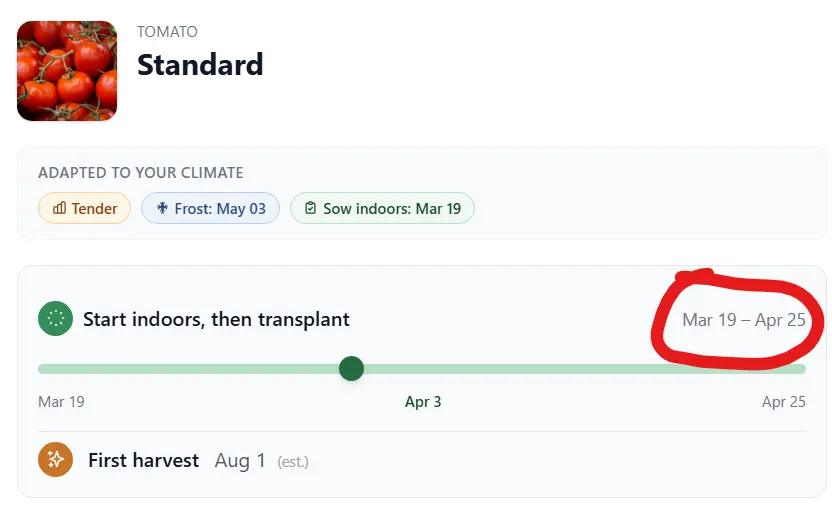
Leaftide calculates this automatically. When you add a variety to your plan, it shows you the optimal sowing window based on your location and setup. Not a vague “spring” but actual dates: “Best time to start: 15 April to 30 May.”
More importantly, it tells you when the window is closing. If you’re approaching the latest advisable date, it says so. If you’ve missed it entirely, it doesn’t pretend otherwise. Instead of a guessing game, you get a clear signal.
I’ve found this particularly useful for slower crops like peppers and aubergines. These need heat and time. Miss the window by a few weeks and they won’t fruit before cold weather returns. The system knows this because it factors in growing degree days, not just calendar dates.
When the answer is “next year”
Sometimes the honest answer is that it’s too late. This used to frustrate me, but now I find it oddly reassuring. Instead of starting something doomed to fail, I can switch to planning next season. Leaftide makes this easy: if a variety isn’t viable this year, it offers to add it to next year’s plan instead.
For faster crops, there’s often more flexibility than I expected. Courgettes started in early June still have time to produce. Even some salad crops can go in surprisingly late if your autumn is mild. The point is, I don’t have to guess anymore.
What this means in practice
The “is it too late” question used to cost me hours of searching and still leave me uncertain. Now I check the sowing window for my actual location and setup. Either there’s still time, or I plan for next year. No more forum debates, no more guesswork.
Find your local frost dates with the Frost Date Finder.