How to Grow Celery
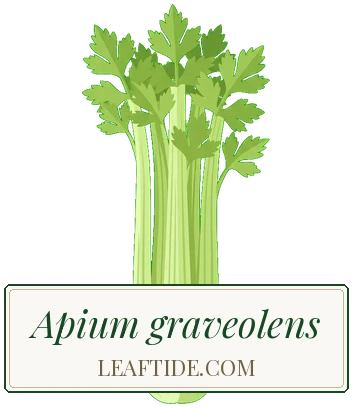
Apium graveolens
Celery needs full sun, rich, moisture-retentive soil, and consistent watering — it will not tolerate drying out. Sow indoors in March at 15–20°C; germination is slow (2–3 weeks). Prick out into modules and harden off before planting out in late May after the last frost. Space 23 cm apart in blocks for self-blanching types, or in trenches for trench celery. Feed fortnightly with liquid fertiliser and water copiously. Harvest self-blanching types from late summer; trench celery is hardier and can be lifted into winter.
 In your Leaftide garden
 - Hardiness
- Half Hardy
- Season
- Cool Season
- Harvest
- Continuous Harvest
- Spacing
- 23 cm
- Height
- 45 cm
- Min. soil temperature
- 15°C+
- Start from
- Seed
- Light
- Full sun to part shade
- Water
- High
When to Start
Sow indoors 10 weeks before last frost, or direct sow outdoors after frost risk has passed and soil reaches 15°C.
Don't know your frost date? Find it here →
Growth Stages
Approximate days from start
Care Essentials
- Liquid feed fortnightly. Needs rich, moist soil and consistent watering.
- Self-blanching types are easier but less hardy. Start indoors in March — needs warmth to germinate.
Companion Planting
Tomato, Broad Beans, Runner Beans
Growing Conditions
- Min. soil temperature
- 15°C+
- Germination temperature
- 15–21°C
- Sow indoors
- —
- Transplant out
- —
- First harvest
- —
Want your full season plan with reminders? Set up your garden free


Spacing & Planting
| Plant spacing | 23 cm |
| Row spacing | 23 cm |
| Sow depth | 0 cm |
| Mature height | 45 cm |
| Mature spread | 25 cm |
Companion Planting
Grows well with
Celery and tomatoes are mutually beneficial neighbours: celery's pungent foliage — rich in phthalides and terpenes — repels aphids and whitefly that commonly attack tomatoes, while tomato's dense canopy provides partial shade that reduces celery bolting in warm spells.
▼Broad beans harbour Rhizobium bacteria in root nodules that fix atmospheric nitrogen into plant-available ammonium, directly enriching the soil around the nitrogen-hungry celery. Chop and drop bean stems at the end of the season to release stored nitrogen as they decompose.
▼Runner beans fix atmospheric nitrogen via Rhizobium root nodules, steadily releasing ammonium into the soil that feeds nitrogen-hungry celery over the season. Grow them on a trellis directly behind the celery row so the beans don't shade out the shorter crop.
▼Celery's aromatic phthalide compounds act as an olfactory mask, disrupting the host-location ability of cabbage white butterflies and reducing egg-laying on nearby brassicas. Interplant celery every third or fourth cabbage to create a distributed chemical barrier.
▼Celery and leeks share similar moisture requirements and grow to compatible heights, making efficient use of bed space without competing aggressively. Their combined volatile profiles — phthalides from celery and sulphur compounds from leeks — create a mixed scent that confuses a wider range of pests than either alone.
▼Onion's sulphur volatiles and celery's phthalide scent together create a layered aromatic barrier that confuses a broad range of leaf-feeding insects navigating by smell. Both crops also prefer consistent moisture and similar pH, so they thrive under the same watering regime.
▼Keep away from
Both celery and parsnip belong to the Apiaceae family and share the same fungal and bacterial pathogens — most notably celery leaf spot (Septoria apiicola) and Sclerotinia — which can spread readily between them. Maintain at least 60 cm separation and avoid planting one in soil where the other grew the previous season.
▼Celery and potatoes both draw heavily on potassium and phosphorus, creating direct root-zone competition that stunts both crops when grown in close proximity. Potatoes also produce allelopathic glycoalkaloids that leach into the surrounding soil and can suppress celery seedling establishment; keep them at least 50 cm apart.
▼Pests & Diseases
Pest Celery Leaf Miner
Identification: Brown blotchy mines within leaves where larvae tunnel between leaf surfaces, leaves become papery and brown
- Squash larvae within leaf mines by pressing between finger and thumb
- Remove and destroy badly affected leaves promptly
- Cover with fine mesh from planting to prevent adult flies laying eggs
- No effective chemical treatments once larvae are inside leaves
Pest Slugs and Snails
Identification: Irregular holes in stems and leaves, slime trails, seedlings eaten at ground level
- Beer traps
- Nematode biological control
- Evening hand-picking
- Copper barriers around beds
- Ferric phosphate slug pellets
Pest Carrot Fly
Identification: Rusty brown tunnels in stems near the base, wilting foliage, small creamy-white maggots
- Fine mesh barriers at least 60cm high around the crop
- Avoid bruising foliage which releases scent attracting flies
- Companion plant with strong-smelling alliums
- Limited options for home gardeners
Disease Celery Leaf Spot Septoria apiicola
Symptoms: Small brown spots with dark borders on leaves and stems, spots merge causing leaves to die back, can spread to stalks
Treatment: Remove and destroy affected leaves promptly, improve air circulation
Prevention: Use disease-free or treated seed, avoid overhead watering, rotate crops on a 3-year cycle
Disease Celery Heart Rot
Symptoms: Soft, slimy brown decay in the centre of the plant, foul smell, outer stalks may look healthy initially
Treatment: Remove and destroy affected plants immediately, do not compost
Prevention: Ensure good drainage, avoid damaging plants when weeding, do not earth up too tightly
Growing Conditions
| Min. soil temperature | 15°C |
| Germination temperature | 15–21°C |
| Base growth temperature | 5°C |
| Min. daylength to start | 10h |
| Photoperiod sensitivity | day neutral |
Frequently Asked Questions
- How far apart should I plant Celery?
- Plant Celery 23cm apart with 23cm between rows.
- When can I harvest Celery?
- Celery is ready to harvest approximately 100 days after transplanting.
- What grows well with Celery?
- Celery grows well with tomato, broad beans, runner beans.
- Is Celery frost hardy?
- Celery is classified as Half Hardy.