How to Grow Virginia Creeper
Parthenocissus quinquefolia
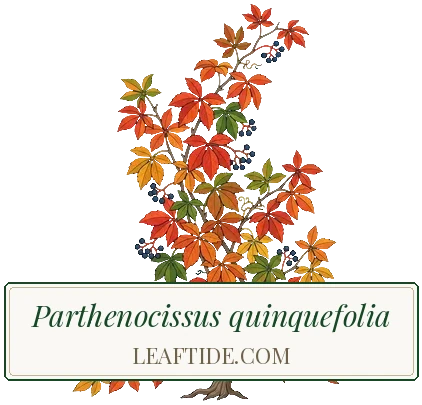
Virginia creeper is a vigorous self-clinging deciduous climber grown primarily for its spectacular crimson-red autumn colour. Covers large walls quickly via adhesive pads. Extremely hardy and tolerant of any aspect including full shade. Requires regular pruning to keep away from gutters, windows, and roof tiles. Berries are toxic to humans but valued by birds.
 In your Leaftide garden

- Height
- 1200 cm
- Spread
- 500 cm
- Light
- Full sun to part shade
- Water
- Low
- Feed
- Rarely needed
- Prune
- Prune at least twice a year
Yearly Lifecycle
Care Essentials
Rarely needs feeding. A mulch of compost at the base in spring is beneficial for young plants but established specimens are self-sufficient.
Watch For
- Growth into gutters and under roof tiles
- Adhesive pads damaging render or paintwork
- Japanese beetle (in some areas)
Care Requirements
Light
Extremely adaptable, full sun to full shade
Thrives in any aspect. Autumn colour is most vivid in full sun; in deep shade the display turns yellow rather than red.
Watering
Drought-tolerant once established
Water regularly throughout the first growing season to help roots establish. Mature plants rarely need supplementary watering except during prolonged drought.
Fertilizing
Rarely needed
A mulch of well-rotted compost applied in spring around the base of young plants is sufficient. Established plants on most soils need no additional feeding.
Pruning
Prune at least twice a year
Cut back hard in summer to prevent growth reaching gutters, windows, and roof edges. Follow with a structural tidy in late winter while dormant. Tolerates drastic cutting back if renovation is needed.
Overwintering
Fully hardy, no protection needed
Hardy throughout the UK and most of northern Europe to at least -20°C. The plant is deciduous and will lose all foliage in autumn — this is normal.
Growing Tips
Self-clinging but adhesive pads can damage soft render
Virginia creeper attaches itself with adhesive pads — no wires or trellis needed. However, these pads can damage soft render, lime plaster, or porous brick. Fix to timber, hard stone, or masonry only.
Prune at least twice a year
Cut back in summer to keep growth away from gutters, windows, and roof edges. Follow up with a structural prune in late winter while dormant. Untrimmed plants can block gutters and lift roof tiles within a season.
Berries are toxic to humans but valuable to birds
The small dark blue-black berries that form in autumn are toxic to humans if eaten in quantity; their safety for pets is unconfirmed. However, they are an important food source for birds such as thrushes and blackbirds — leave them in place if possible.
Autumn colour is best in full sun
The spectacular scarlet and crimson autumn display is most vivid when the plant receives good sun exposure. In deep shade the foliage tends to turn yellow-green rather than red, and the display is noticeably reduced.
Pests & Diseases
Pest Vine Weevil
Identification: Adult weevils notch leaf margins in spring and summer, but it is the creamy white larvae that cause serious damage by feeding on roots through autumn and winter. Affected plants wilt suddenly and may die.
- Apply nematodes (Steinernema kraussei) to moist soil in late summer or early autumn when larvae are small.
- Ensure adequate soil moisture for nematode survival.
Pest Aphids
Identification: Colonies of aphids may cluster on new shoot tips and the undersides of young leaves in spring, causing leaf curl and stunted growth. Usually managed by natural predators.
- Encourage natural predators such as ladybirds and lacewings.
- For heavy infestations on reachable shoots, use a strong jet of water or an insecticidal soap spray.
Pest Japanese Beetle
Identification: In affected regions (primarily North America), Japanese beetle adults skeletonise leaves rapidly in summer, leaving only the veins. Can defoliate large sections of the plant.
- Hand-pick adults in the morning when they are sluggish.
- In high-pressure areas, use approved beetle traps or neem-based sprays.
- Check regional guidance as this pest is absent from most of Europe.
Disease Powdery Mildew
Symptoms: White powdery coating on upper leaf surfaces, typically in late summer during hot dry spells followed by humid nights. More disfiguring than fatal.
Treatment: Improve air circulation by thinning dense growth. Avoid overhead watering. Remove affected leaves promptly. A dilute bicarbonate spray or sulphur-based fungicide can slow progression.
Prevention: Water at the base in the morning, avoid planting in a dry, airless spot, and mulch to keep the roots evenly moist.
Disease Leaf Spot
Symptoms: Circular brown or black spots with yellow halos on leaves, caused by various fungal pathogens. Usually occurs in wet summers or when foliage remains damp.
Treatment: Remove and dispose of affected leaves; do not compost them. Avoid wetting the foliage when watering. Ensure good airflow around the base of the plant.
Prevention: Clear fallen leaves in autumn, water at the base rather than over the foliage, and keep growth thinned enough for air to move through.